
Anneal
Music, speech, images and text — generated entirely on one machine. Nothing you write or make leaves it.
What it is
A single Apple silicon Mac that makes music, speech, images and text on demand — for anyone on the machine, and for anything on your network that can make an HTTP request.
Anneal started as plumbing. The gap in what coding agents could produce was never the code; it was everything around it. A game with no music. A demo with no voiceover. An interface with grey boxes where the artwork should be. All of that is available from hosted services, at the cost of an account, a key, a bill per request, and your work leaving the building. Anneal puts the generative models on hardware you already own, behind one address, and lets the development workflow call them directly. Nothing is metered, and no prompt or generated file is sent to a model provider.
What it makes
- Press
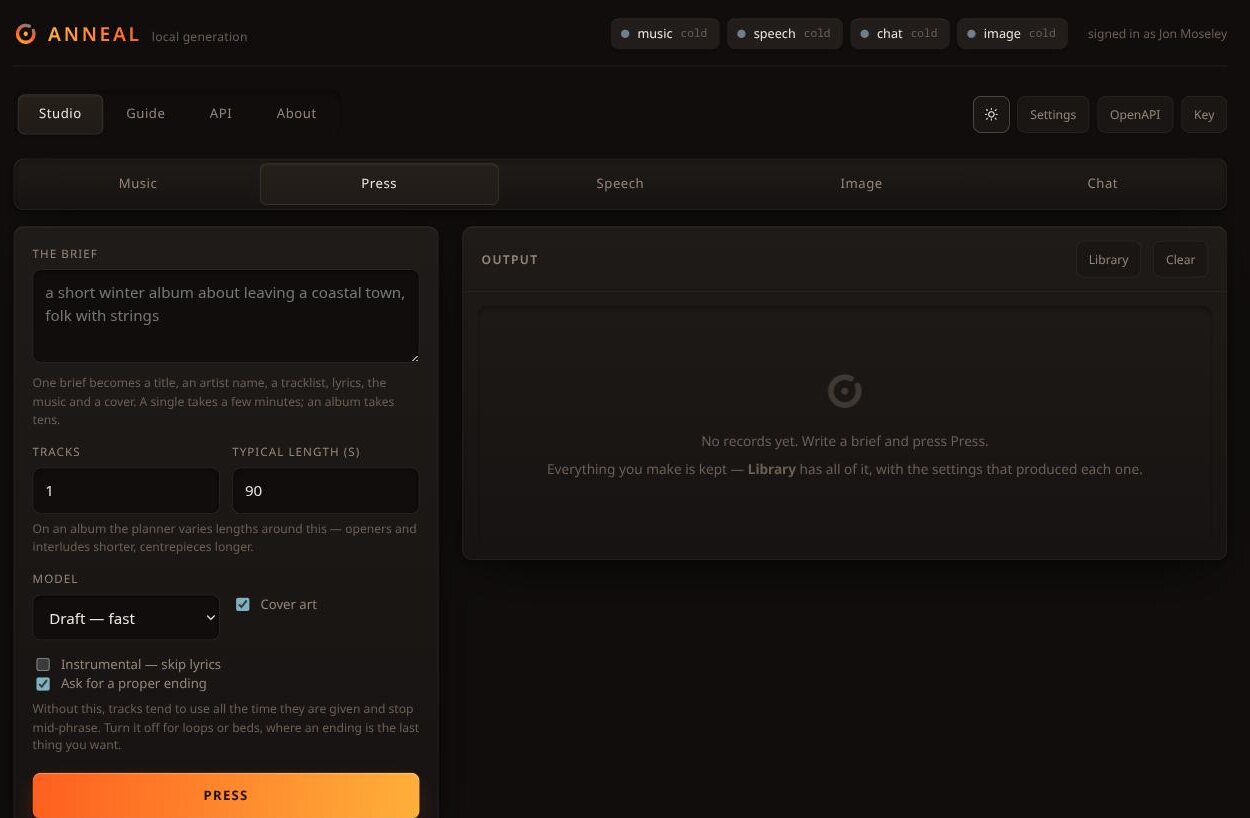
One brief becomes a single or an album — title, artist, tracklist, lyrics, finished audio and a cover, in one call. A single takes a few minutes; an album takes tens.
- Music
A track from a description, with or without vocals. Up to ten minutes.
- Speech
28 plain voices, about a second a sentence, and nine you can direct.
- Image
Stills up to 1536px.
- Chat
A local language model, streamed — and the thing that writes the lyrics.
Two ways to use it
By hand: pick a mode, write a line, press Forge. The interface tells you what a request will cost before you commit to it — a cold music model is minutes, not seconds — and everything you make is kept, with the settings that produced it.
By API, or by agent: one HTTP gateway with an OpenAPI spec and an MCP server, so a build script — or a coding agent like Claude Code — can score a game, voice a demo or draw its own artwork without a hosted service in the loop. Both talk to the same gateway; the browser has no privileged path.
Why “Anneal”
Annealing is heating metal and letting it cool slowly, so it settles into a better state than it started in. It is also, almost exactly, what this has to do with its models: they want more memory than one machine has, so each is heated up on demand and allowed to cool when the work stops. That constraint shapes everything — the ordering of Press’s stages, the eviction rules, the warnings before a slow request.
What it runs on
- Hardware
- Apple silicon Mac, macOS
- Memory
- 16 GB unified minimum — a tested floor, not a recommendation. At 16 GB the music model already exceeds physical RAM and pages throughout a generation; more memory is mostly faster because less of it is spent paging.
- Disk
- Around 40 GB for weights, environments and the library
Nothing else works today, for two separable reasons. Speech, images and text run through MLX, which is Apple-silicon only; and the model lifecycle — when to evict, when to refuse, when to warn you about the host — rests on macOS-only system calls for memory pressure, paging and real process footprint. Contributions and ports are welcome.
Built on
Anneal is a gateway and some glue; the hard parts are other people’s work, running locally and unmodified but for two documented patches to ACE-Step. Music is ACE-Step 1.5, speech is Kokoro-82M, images are FLUX.1-schnell, text is Gemma 4 E4B — on MLX, mlx-audio and mflux. The gateway itself is Python’s standard library, no web framework. Tailscale carries the connection and the caller’s identity, so reaching Anneal from another device needs no open port.
Source
Anneal’s own code — the gateway, Press, the MCP server and the interface — is MIT licensed.